
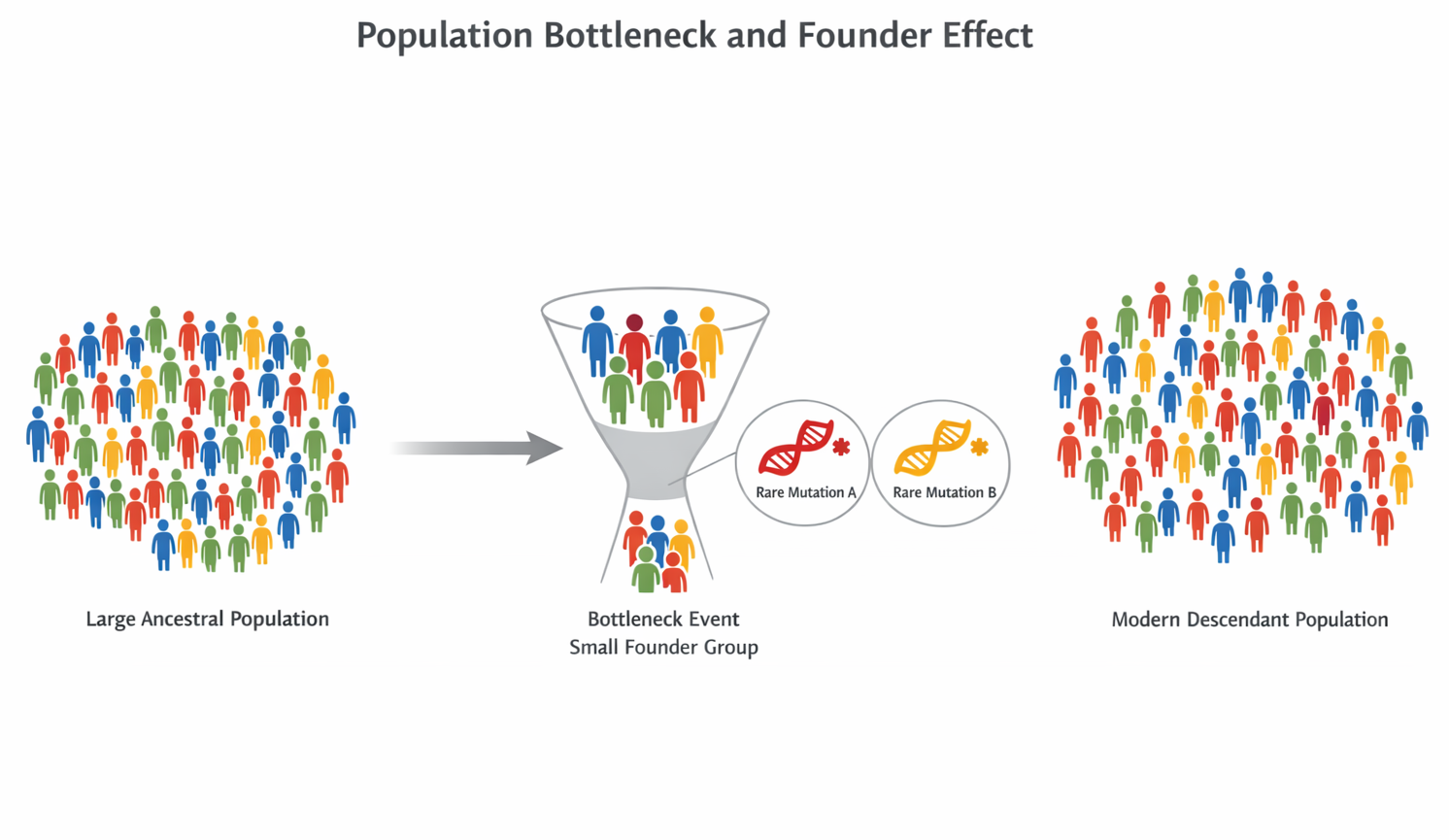
India’s population history has profoundly shaped its present-day health landscape. Centuries of endogamy, geographic isolation, and repeated population bottlenecks have led to the concentration of rare genetic variants within specific communities. These founder effects mean that conditions considered rare at a global level may be relatively common within certain Indian populations. This figure illustrates how a large ancestral population with wide genetic diversity undergoes a bottleneck, where only a small subset contributes to future generations. By chance, certain rare genetic variants become overrepresented among these founders. When the population later expands, overall numbers recover but genetic diversity does not, resulting in amplification of specific variants. In the Indian context, centuries of endogamy and social isolation have created thousands of such founder populations, allowing inherited cardiac risk to cluster within families and communities. This is not a sociological observation but a biological one: when small ancestral groups expand over generations with limited outside genetic mixing, chance alone allows certain pathogenic variants to persist and amplify. As a result, genetic risk in India is often clustered within families and communities, creating predictable patterns of disease that conventional epidemiological models fail to capture.
This population structure also makes India a largely untapped opportunity for medical genetics. As David Reich has provocatively observed, identifying disease-causing genes in India can be cheap, fast, and high-yield—if we choose to do it. The pathway is straightforward: identify clusters of recurrent disease, sequence a small number of affected individuals, map founder mutations, and translate these findings into targeted screening and counselling. Much of this information already exists informally. Local clinicians often know that a particular malformation is common in a specific community or that unexplained neonatal deaths recur within certain families. This knowledge, preserved in clinical memory rather than formal databases, represents a vast but underutilized genetic resource.
These genetic patterns frequently surface in clinical practice, but in fragmented and easily overlooked ways. Individuals may present with recurrent syncope, unexplained arrhythmias, or sudden collapse despite having structurally normal hearts on routine testing. Sudden deaths often occur during sleep, physical exertion, fever, or emotional stress—settings characteristic of inherited arrhythmic disorders—but are commonly labelled as myocardial infarction, epilepsy, stroke, or accidental causes. Low autopsy rates, inconsistent death certification, and limited access to longitudinal medical records further obscure inherited causes. Because each event is evaluated in isolation, clinicians fail to recognize familial clustering, allowing the same pattern of sudden or unexplained death to recur across generations without intervention.
From my years of experience as a cardiologist I feel, genetics can no longer be considered as a distant or esoteric discipline—it has become inseparable from everyday clinical judgment. Years of practice reveal a recurring pattern: patients with normal investigations who nevertheless return with unexplained events, and families in which tragedy repeats despite “reassuring” assessments. Experience teaches that normal tests do not always equate to low risk and that clinical intuition, informed by family history and circumstance, often precedes definitive diagnosis. Genetics, in this context, is not about sequencing every patient, but about recognizing when biology, history, and pattern demand deeper attention. Ignoring this perspective risks mistaking uncertainty for safety.
Syncope occupies a central role as an early warning sign in this sequence. In many inherited cardiac disorders, including channelopathies and early cardiomyopathies, ECGs and echocardiograms may remain normal until a catastrophic arrhythmic event occurs. This creates a false sense of reassurance and leads to underestimation of risk, particularly in young patients. Syncope occurring during exertion, sleep, or febrile illness, or syncope repeatedly attributed to dehydration or vasovagal causes, should prompt deeper evaluation. Careful three-generation family histories—documenting sudden deaths, unexplained drownings, seizure-like episodes, early pacemaker implantation, or extreme responses to medications or anesthesia—often reveal risk patterns invisible to standard investigations.
If we already know that thousands of Indian communities carry predictable lethal mutations, that simple screening could prevent suffering, that the cost is low, and that the benefit is enormous, then continued inaction raises an uncomfortable question about modern medicine’s priorities. The barrier is not ignorance; it is avoidance—avoidance of complexity, of responsibility beyond the individual encounter, and of the discomfort that comes with acknowledging preventable risk. India’s genetic history is neither a burden nor an embarrassment; it is one of the greatest untapped opportunities in global preventive medicine, waiting for clinicians willing to act with disciplined compassion.
Many sudden cardiac deaths in India are biologically patterned rather than random and can be prevented through thoughtful clinical practice. Prevention does not require universal genetic testing or advanced infrastructure, but careful clinical reasoning, systematic family mapping, and restraint before offering reassurance. When inherited risk is recognized, targeted screening and early intervention can break cycles of tragedy that would otherwise repeat silently across generations. Integrating population genetics into everyday bedside care allows medicine to move from reactive explanations to proactive prevention.
0 Comments