
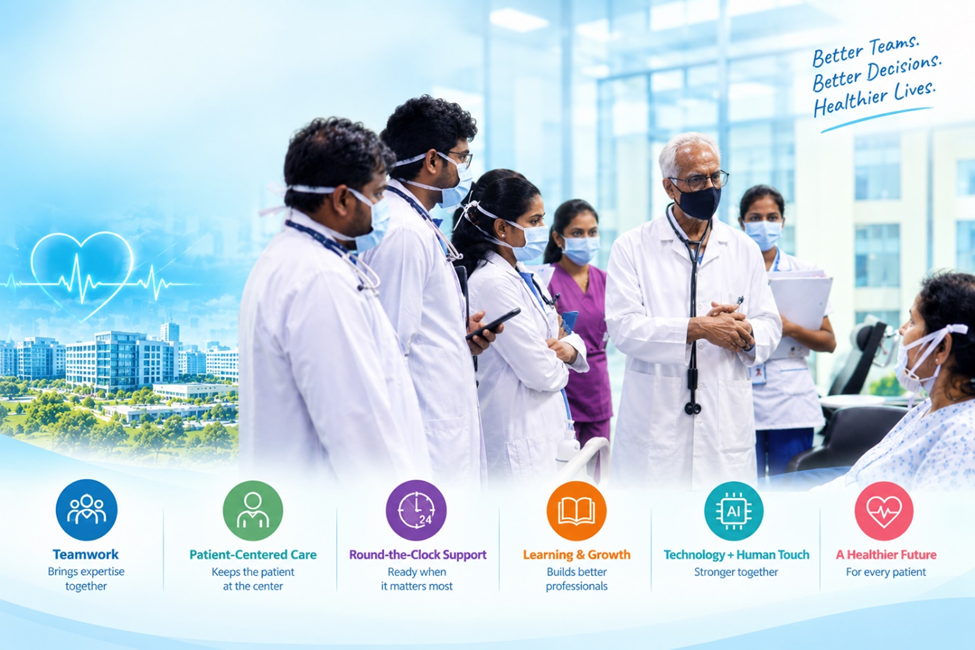
Medicine has traditionally been associated with the individual physician—the doctor whose knowledge, clinical judgment, and personal commitment guide the patient’s care. While the role of the individual doctor remains fundamental, the increasing complexity of modern medicine has made one principle clear:
The best patient care is achieved when skilled professionals work together as a coordinated team.
The philosophy of group practice is not simply about bringing specialists under one roof. It is about sharing responsibility, integrating expertise, and ensuring that the patient receives the right care at the right time.
The Beginning of a Team-Based Approach to Cardiology
In 1985, during our tenure in Cardiology at Nizam’s Institute of Medical Sciences (NIMS), Hyderabad, a model of cardiology group practice was initiated, as described in the historical account of this development. The approach brought together a group of cardiologists working as a coordinated clinical unit, with a focus on round-the-clock cardiac care.
The underlying principle was simple:
Heart disease does not follow office hours.
Cardiac emergencies can occur at any time, and patients should not have to wait for a particular doctor to become available. Through the group practice model, round-the-clock availability of cardiologists was ensured, providing patients with access to specialist cardiac care whenever it was needed. This required coordinated clinical coverage, senior medical guidance, nursing vigilance, diagnostic readiness, and the ability to mobilize emergency procedures when necessary.
An important aspect of this approach was the emphasis on shared leadership and the development of future leaders. In our department, the Head of the Department role followed a rotational system, with leadership responsibilities changing approximately every three years. This was not merely an administrative arrangement, it was an opportunity to ensure that different members of the department had the experience of taking responsibility, providing leadership, making decisions, and working closely with the entire team.
The rotation also encouraged every senior member to understand that leadership is not about individual authority, but about responsibility towards the team and, ultimately, towards the patient. It provided an opportunity for different leadership styles and perspectives to contribute to the department, while allowing colleagues to experience both leading and supporting one another. In this way, leadership became a shared responsibility rather than the preserve of one individual.
We believe that this is an important strength of group practice: it does not merely create a team to deliver care; it creates an environment in which people learn to lead, to collaborate, to accept responsibility, and to respect the contribution of every member of the team.
This represented an important shift from dependence on one individual physician to a system in which the collective presence and expertise of the cardiology team ensured continuity of care, day and night. The responsibility for the patient was shared, and the service remained prepared to respond whenever an emergency arose.
The important lesson is that 24-hour care does not require one doctor to remain available 24 hours a day. It requires a well-organized team in which responsibility is handed over appropriately, senior expertise remains accessible, and the system is prepared to respond.
From Cardiology Group Practice to Institution-Wide Teamwork
In Cardiology, we have been practising the group practice model since our days at NIMS. Over the years, this experience has reinforced our belief that complex healthcare cannot depend on the efforts of one individual alone. It requires a coordinated team in which every member contributes their knowledge, skills, and commitment to patient care.
And this is not simply a philosophy that we have discussed, it is something we have experienced in practice.
Over the years, countless patients have come through our doors at moments of crisis, when every minute mattered. Many of those patients were able to receive timely intervention because a team was present, because one doctor could rely on another, and because responsibility for the patient did not rest with a single individual.
There are lives that were saved because the system worked as a team. For those of us who have experienced such moments, this is perhaps the most powerful affirmation of what group practice can achieve.
Our experience in Cardiology has led us to believe that the same principle must extend beyond Cardiology to every department in the hospital. Each department should function as a cohesive team, while all departments must work together as one integrated healthcare system.
Whether it is Medicine, Surgery, Nursing, Radiology, Laboratory Services, Emergency Care, or Administration, every function has a role in ensuring that the patient receives safe, timely, and compassionate care.
The central purpose of every department, every professional, and the institution as a whole must remain the same:
The patient is the most important person in the healthcare system.
Departmental boundaries, individual recognition, and professional differences should never take precedence over the patient’s needs and well-being.
When every department works with this shared purpose, group practice becomes more than professional collaboration. It becomes a culture of collective responsibility, where the success of one department supports the success of the entire institution and, ultimately, better outcomes for every patient.
From “My Patient” to “Our Responsibility”
Group practice requires a change in professional culture. The patient should not be viewed as belonging to an individual physician but as the shared responsibility of the clinical team.
Modern patients often require several specialists. A cardiologist, cardiac surgeon, nephrologist, radiologist, intensivist, nurse, and rehabilitation professional may each contribute to different aspects of care. However, the patient needs more than a collection of individual consultations. The patient needs a coordinated plan.
This is a lesson reflected in the philosophy of the Mayo Clinic, where cooperation in medicine has long been associated with putting the patient’s interests first. The Cleveland Clinic model also highlights the importance of physician leadership, organizational structure, measurement, and continuous improvement.
A hospital may have many highly qualified specialists, but that alone does not make it a genuine group practice. Collaboration requires trust, communication, shared information, and a willingness to seek assistance when another professional’s expertise is needed.
In our experience, the strength of a team is also measured by its willingness to listen. Even the most junior member should feel confident raising a concern when something does not appear right. In medicine, speaking up is not a challenge to authority; it is an act of responsibility toward the patient.
The Patient Must Remain at the Center
Specialization has brought remarkable advances in medicine, but it can also lead to fragmentation. A patient may be seen by several departments, with each focusing on a particular organ or clinical problem.
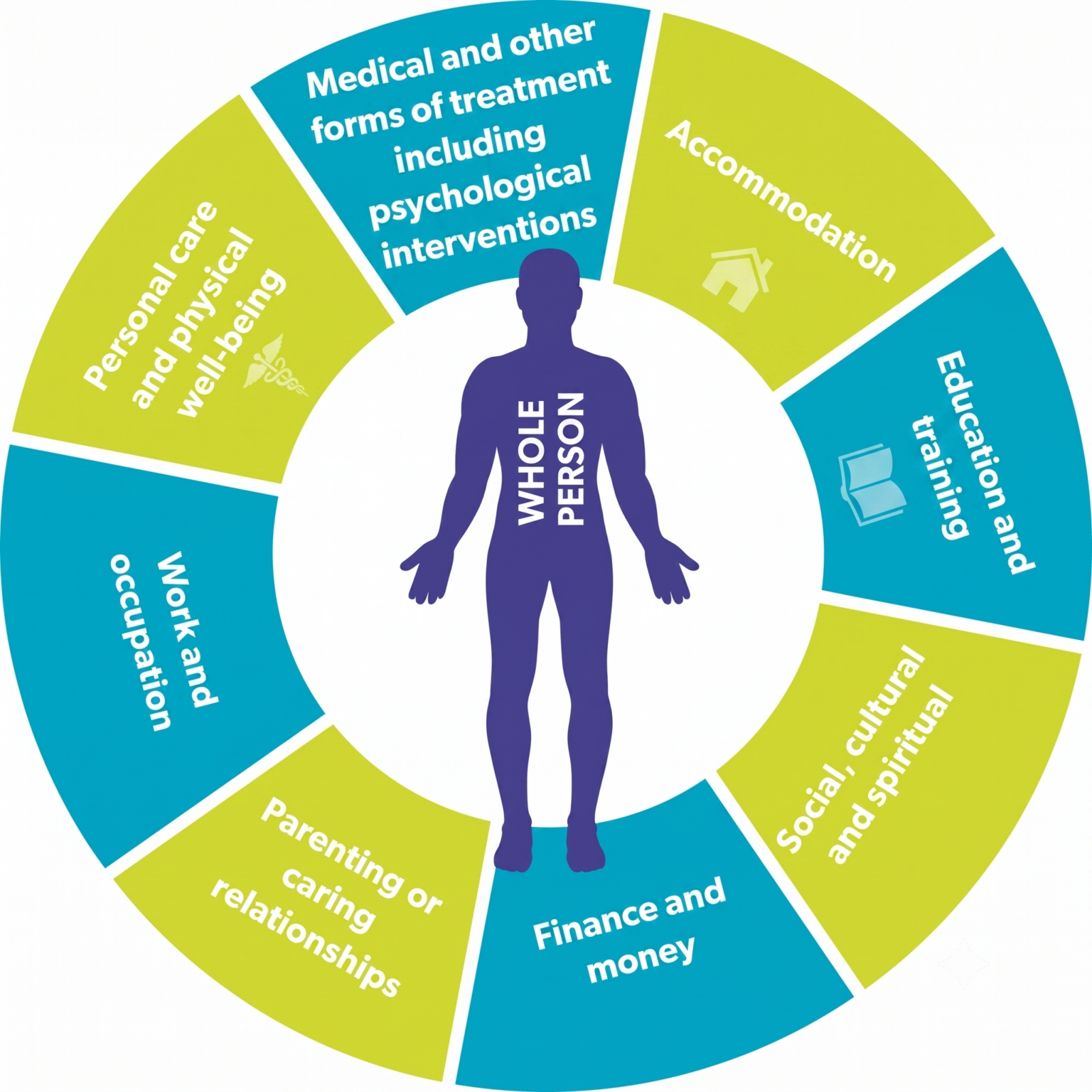
The responsibility of a modern healthcare institution is to ensure that these different perspectives come together around the whole patient.
The cardiologist must understand the patient’s broader health. The surgeon must consider recovery and long-term outcomes. The intensivist must recognize the patient’s clinical journey before critical illness. The radiologist and other specialists must contribute to integrated diagnostic reasoning.
The question should not simply be:
“What is happening in our area of expertise?”
It should also be:
“What is happening to this person, and what is the best overall plan?”
This requires both specialist knowledge and physicians who can integrate the patient’s complete clinical picture.
Teamwork, Education, and the Future of Healthcare
Group practice creates an environment in which doctors learn from one another. Young physicians benefit from exposure to different clinical approaches, shared decision-making, mentorship, and the experience of managing difficult cases as a team.
It also encourages professional accountability. Individual autonomy remains important, but it must be balanced with communication, evidence, and responsibility toward the wider team.
Technology, including artificial intelligence, will increasingly support healthcare through improved information management, diagnostics, predictive analytics, and clinical coordination. However, technology alone cannot create an excellent healthcare system.
AI should strengthen the clinical team, not replace human judgment, responsibility, and compassion.
The future of medicine lies in combining skilled professionals, integrated information, effective organizational systems, and meaningful patient participation.
Conclusion: Building a Dependable Healthcare System
The development of group practice in cardiology and the lessons from institutions such as Mayo Clinic and Cleveland Clinic point toward a common principle: healthcare must evolve from isolated individual excellence to coordinated institutional responsibility.
A great physician can make a significant difference in a patient’s life. A great clinical team can ensure that expertise, support, and continuity are available when patients need them.
Our experience has taught us something even more profound. Behind every statistic, every emergency call, every procedure, and every successful recovery is a human life. Over the years, there have been countless patients whose lives were saved through timely teamwork. Each one is a reminder that medicine is not ultimately about who treated the patient but it is about whether the patient received the help they needed, when they needed it.
The objective should be to build institutions where doctors work together, nurses and allied professionals are empowered, young physicians learn through collaboration, and every patient receives care based on clinical need.
For us, the true measure of group practice is not how many doctors work in an institution. It is whether, when a patient needs help, the entire institution can respond as one team.
And perhaps that is the greatest meaning of collective responsibility in medicine:
The greatest achievement of group practice is not simply that doctors work together. It is that, when a patient is at their most vulnerable, they are never left alone by the healthcare system.

0 Comments