
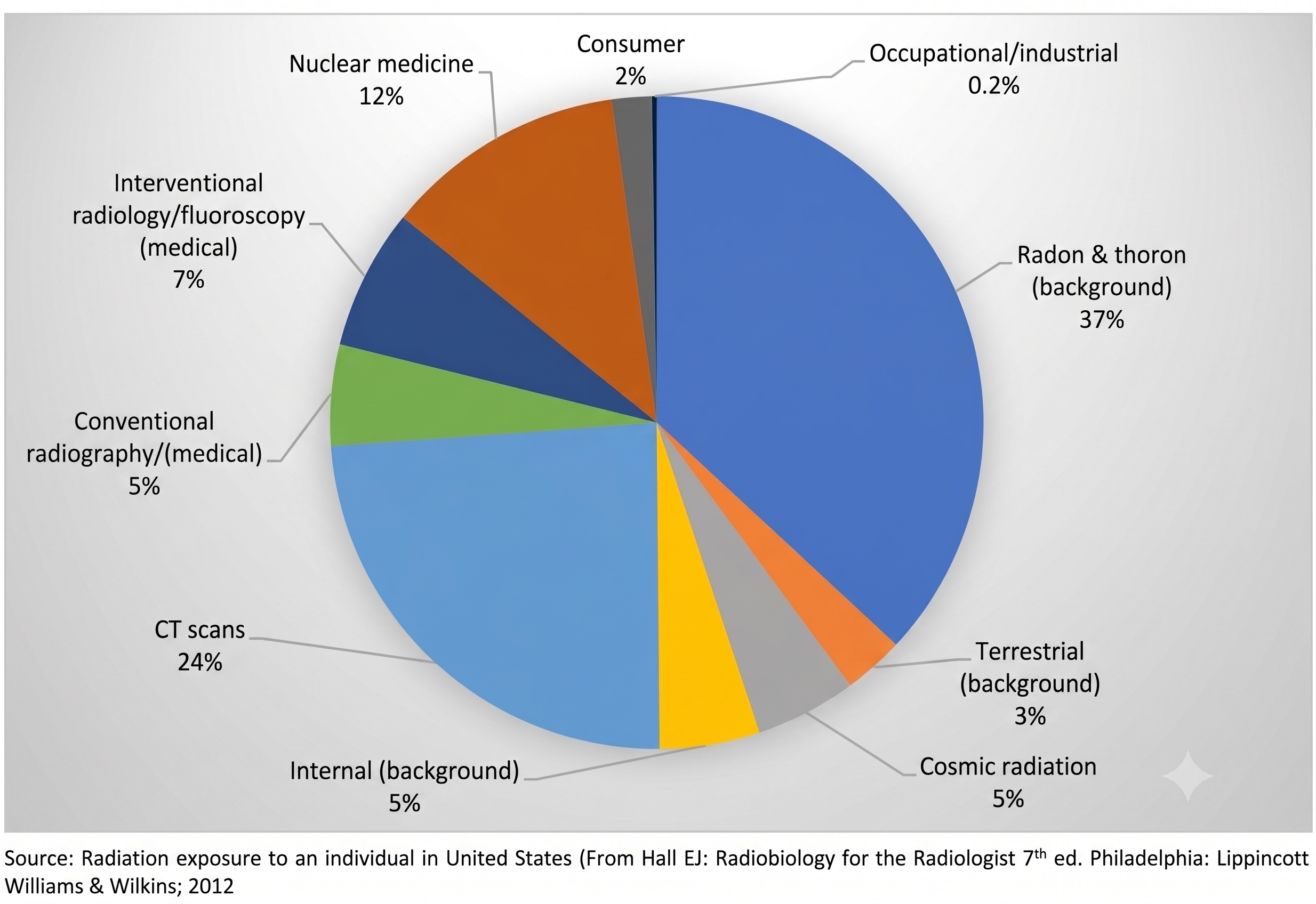
Medical imaging has transformed how we diagnose and manage disease, offering clarity and confidence in clinical decision-making. However, as the use of advanced modalities such as CT, fluoroscopy, and nuclear scans grows, so does our responsibility to ensure that these technologies are used judiciously and safely. Radiation safety is not merely a technical protocol—it is a vital component of ethical medical practice.
The Hidden Risk Behind Diagnostic Power
Ionizing radiation, used in CT and other imaging methods, can damage DNA and living tissues. While a single scan poses minimal risk, repeated or unnecessary exposures accumulate, increasing the likelihood of long-term effects such as cancer. These risks are stochastic—their severity does not depend on the dose, but the probability of occurrence increases with cumulative exposure.
In India, where the use of CT and interventional imaging is rapidly expanding, this issue carries public health implications. The Indian Council of Medical Research (ICMR) reports that cancer incidence is steadily rising, with over 14 lakh new cancer cases diagnosed annually, a number projected to exceed 15.7 lakh by 2025. While lifestyle and environmental factors are major contributors, medical radiation exposure is an increasingly recognised component of this complex epidemiologic shift, particularly with the surge in high-dose imaging studies.
The guiding philosophy of CT safety rests on two pillars—Justification and Optimization. Justification means performing “the right scan for the right reason,” only when it is expected to change patient management. Optimization, on the other hand, focuses on performing “the scan right”—using the lowest radiation dose necessary to achieve diagnostic image quality. This is achieved through modern dose-saving technologies such as automatic exposure control, tube current modulation, iterative reconstruction algorithms, and careful restriction of the scan range to the area of clinical concern.
From an epidemiologic perspective, CT contributes nearly half of all medical radiation exposure in developed nations. Studies have indicated a modest but measurable increase in long-term cancer risk associated with repeated CT exposure—particularly hematologic malignancies and thyroid cancers in younger patients. These findings emphasise the ethical obligation of clinicians to balance diagnostic benefit with radiation risk, particularly for vulnerable populations such as children and young adults.
Radiation safety in CT imaging is anchored in the ALARA principle—As Low As Reasonably Achievable. In practice, this means continuously refining scanning protocols, auditing dose indices (CTDIvol, DLP), and educating both clinicians and patients about radiation risks and alternatives. National initiatives such as the “Image Gently” and “Image Wisely” campaigns have further strengthened awareness and provided actionable guidance for both paediatric and adult imaging.
The evolution of technology has also brought promising advancements. AI-driven dose optimization, real-time dose monitoring systems, and automatic exposure feedback mechanisms allow radiology departments to benchmark and continually improve safety practices. These tools not only reduce dose variability between institutions but also enhance patient protection across diverse clinical settings.
Despite its risks, CT remains one of the most valuable diagnostic tools in medicine—a cornerstone of early detection, precision diagnosis, and therapeutic planning. Yet, as physicians, our duty extends beyond detection; it encompasses protection. Each scan must reflect thoughtful judgment, balancing the need for diagnostic certainty with the responsibility to minimize harm.
Modern scanners, aided by artificial intelligence and iterative reconstruction algorithms, can now produce high-quality images at significantly lower doses. Yet, technology alone cannot guarantee safety—it must be coupled with clinical judgment, education, and patient awareness.
From a cardiologist’s standpoint, CT imaging—particularly coronary angiograms and cardiac CT scans—has transformed how we diagnose and manage coronary artery disease. These modalities allow for non-invasive visualization of coronary anatomy, plaque burden, and cardiac function with remarkable precision.
However, in today’s world, the decision to perform advanced imaging—especially those involving radiation—is not always guided by true clinical necessity. The mere availability of a diagnostic modality or the skill to perform the test does not, by itself, justify its use. Each investigation must be driven by a clear clinical indication and an expectation that the results will meaningfully impact patient care.
With the increasing popularity of annual “master health check-ups” that include CT scans, there is growing concern about unwarranted radiation exposure. While these packages are often marketed as comprehensive and preventive, the inclusion of CT scans without clinical justification can do more harm than good.
Each CT scan imparts a significant radiation dose—a CT Brain equals 100 Chest X-rays, a CT chest equals roughly 350 chest X-rays, and a CT abdomen about 500. Repeated exposure, especially when not medically necessary, adds cumulative risk over time.
Before undergoing such imaging, patients should consult their primary physician or seek a second opinion to ensure that the scan is truly indicated and beneficial. Preventive health must never come at the cost of unnecessary radiation risk.
Likewise, overuse of cardiac CT or angiographic studies without appropriate justification can lead to unnecessary radiation exposure and incidental findings that may complicate patient management rather than clarify it. Therefore, judicious selection of patients for these tests is crucial. In many cases, non-ionizing alternatives like echocardiography or cardiac MRI can provide adequate information without radiation risk.
Ultimately, the guiding principle remains:
Perform the right test, for the right patient, at the right time—ensuring that technology serves the patient, not the other way around.
“CT technology allows us to see deeply into the body; our wisdom must ensure we do not harm what we see.”


0 Comments